Does Reading Help With Word Finding After a Stroke
As Michael McHale searches for the words, he closes his eyes to concentrate and procedure.
"I know what I want to say, but it doesn't come out clearly," McHale said, in betwixt deep pauses and breaths. "I'm sorry, but I hear everything. I know everything that'southward going on around me, but I but can't respond to things as rapidly I used to."
McHale, 51, had a stroke near two years ago. The blood clot in his brain affected an area responsible for linguistic communication production and processing, inhibiting his ability to communicate conspicuously.
"It's a tough affair," he said. "I started out with one word per day."
McHale has aphasia, normally caused by a trauma in the encephalon. Experts worry the condition has been then widely misunderstood, that it'southward leading to missed rehabilitation opportunities and intense isolation for many of the estimated 2 1000000 or more people nationwide who develop it. And yet, science owes a lot to this condition, to what it has revealed about how language and even the brain itself works.
What aphasia is and what it isn't
Aphasia can manifest differently for different people, depending on the type of trauma to the brain. Information technology tin cause difficulties in reading, writing, speaking and comprehension. For some, retrieving certain types of words are a challenge. For others, numbers become all mixed up.
"The way we evaluate information technology is we look at 4 linguistic communication modalities: auditory comprehension, speech production and speech output, reading comprehension and written language skills," said Karen Cohen, a spoken language language pathologist at Moss Rehab's Aphasia Center, one of the oldest aphasia centers in the country.
But Cohen says there is ane thing aphasia does not bear upon.
"Information technology affects language processing, information technology does non affect intelligence," she said. "It'southward really important because when people with aphasia talk, other people think they're stupid, and that tin be the perception."
Some liken the experience of having aphasia to existence in another country, where the language is totally different. You're completely nowadays. You may accept even studied the linguistic communication. Y'all can accept in what's going on around you, and you know what you want to say. But the words — the numbers and even phrases — aren't quite at that place, though they may be right at the tip of your natural language.
Cohen runs weekly "chat cafes" and other support groups at the rehab eye. She sits at the head of a long, rectangular table in a bright room. McHale and a handful of others regularly nourish.
"I realize that I know what I want to say, I know it inside and I can't," a woman seated to the left of Cohen shares, pausing. "And, my hubby is annoyed."
Her situation, where a spouse or friend or caregiver gets aggravated, is really common, according to Cohen. That's why the focus here is on building social connections, confidence and communication strategies for when those words merely won't come, or when they're all jumbled up.
"I'grand a retired microbiologist," said Richard Berman, who'south seated adjacent to the woman.
Berman, 74, had a stroke six years ago, and has since struggled to say that give-and-take – 'microbiologist' – his lifelong profession. Here, everyone encourages him to keep trying, to keep practicing, with the help of some lighthearted teasing.
"We similar to make him say it every bit much every bit nosotros tin," Cohen said, every bit everyone chuckles. "Because of the way speech was affected for his stroke, somebody else tin can say it and not have any trouble with information technology. The strategy he actually uses is to say it 1 syllable at a time, and it comes out perfectly."
Berman recites 'microbiologist' again, hitting every syllable, perfectly.
It's met with cheers and laughter.
The conversation grouping is part of a growing shift in how aphasia is treated, taking what's called a "life participation approach." Information technology's used in addition to one-on-one therapy, and mayhap most importantly, it'southward intended to continue for a very long time. That'south because what scientists at present understand about how the brain repairs itself and how long it takes is irresolute.
Aphasia as a window into the brain
The ability to communicate is so inherent in twenty-four hours-to-twenty-four hours functioning that it tin can easily be taken for granted. And yet aphasia — and what happens when linguistic communication abilities are damaged — has helped shape our unabridged understanding of how linguistic communication and the complex systems that exist behind it work.
"Aphasia in the setting of stroke is actually i of the most important disorders in the history of neurology for establishing the idea that there is a relationship between different regions of the brain, different centers and cerebral ability," said Roy Hamilton.
Hamilton runs the Laboratory for Knowledge and Neural Stimulation at the Academy of Pennsylvania, where he spends his days using the advances of modern imaging technology and neurostimulation techniques to research the brains of of health people and people with chronic strokes. He'south looking into the encephalon itself, for clues about language, in hopes of developing meliorate means to repair those functions when they're damaged.
I of the cases, he says, that actually shook the medical field was a patient known every bit 'Tan' from the mid 1800s.
"And the reason he was referred to as Tan was because after he had his lesion in his brain, that was the sound that he primarily generated. Instead of coherent speech, just 'Tan.' 'Tan', " Hamilton said. "You lot would ask him questions, he would try to reply effortfully, frustratingly, and that's what he would produce: tan."
The famed neurologist Pierre Paul Broca studied Tan, and then his brain once he died. He observed that the left frontal area was the damaged part. What that told him was that for most people, language is localized in the brain, in the front, left hemisphere. At that place'southward an area of the encephalon that even bears Broca'south name.
"And we now often refer to patients who have this problem that predominantly involves the production of language as having a Broca's type aphasia," Hamilton said.
Modernistic imaging points to even more complexities
This idea that certain parts of the brain are responsible for specific functions was big at that fourth dimension, and it continues to this day. Another way to look wait at information technology: damage to 1 part of the encephalon that's responsible for a certain role, similar linguistic communication, will then result in damage to those language abilities.
There is actually manner more to this. A pediatric patient of Thomas Barlow'south in 1877 foreshadowed the complexities, Hamilton says, because fifty-fifty when part of the encephalon that'due south responsible for language is damaged, the brain tin can still recover linguistic communication function. Other areas of the brain may work to recoup, finding alternate paths. Scientists have also since learned that language function is non entirely siloed in just one role of the brain.
"One of the large things that we now understand to exist unlike is that the brain is not static in its function," he said.
The brain has a plasticity — or, neuroplasticity — to it. Hamilton and others are trying to meliorate detect these dynamics and incredibly complex systems with avant-garde imaging, like FMRIs, and other neurostimulation techniques. He has studied dozens of people who've had strokes, whose brains — months and years later — have found alternating pathways for language. Hamilton is trying to notice the brain activeness that lights upwardly in sure parts of the right side of the brain, for example, when these patients undergo language tasks.
He hopes to take what he learns from that enquiry a step further.
A centerpiece of his lab is an electromagnetic stimulation machine.
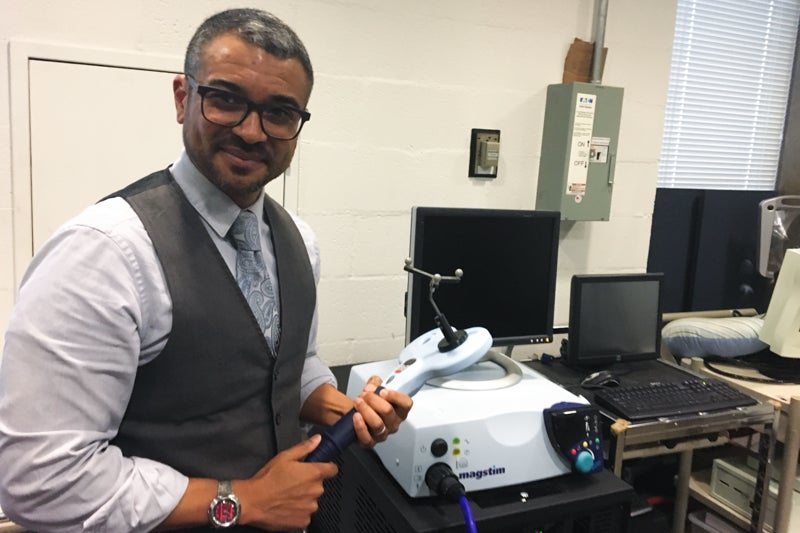
It's about the size of a VCR and has a blue hose coming out of information technology. The multi pronged antenna on the end allows a camera to identify where the hose and coils are in space. When he fires it up, the passing of current jostles the wire inside the coil, inside that hose, producing an electromagnet that then creates a popping or tapping sound.
"In that location's a flux of the wire, and in that moment, the wires scrape confronting each other. That's what you're hearing," Hamilton said. "We tin focally cull an area of the brain and evangelize pulses of a fluxing magnetic field that then generates current in the brain areas and causes encephalon cells at that place to fire."
When those magnetic pulses are directed in a sure targeted way on 1'due south head, the thought is information technology could actuate (or inhibit) specific areas of the encephalon and its related functions. Every bit a pop demo, Hamilton sends pulses to the encephalon's motor cortex, and specifically that part that sends signals downwardly the spinal cord to the hand. When stimulated with magnetic pulses, Hamilton tin can get a person's hand to flinch.
Transcranial Magnetic Therapy is approved past the FDA as a targeted treatment for depression. He wants to figure out how to use such an arroyo to help stimulate and activate linguistic communication recovery. To do that, though, he'll need to effigy out a lot of unknowns, such as what exactly are the properties of how the brain decides which alternate pathways to take, and then how effective those pathways really are.
These are all things that the field of neuroscience continues to explore and debate.
A longterm rehabilitation path
For people with aphasia, like those who wind up at Moss Rehab, in that location'south a more urgent question: how much time does the brain take to repair itself?
Hamilton says the traditional thinking has been that a person by and large plateaus after about six months.
Therapy is critical during that time, but "there is more than evidence to propose that, in general, this arc of recovery is probable much longer than we think information technology is."
As for how long?
"I do not take an endpoint in listen. I call back that the evidence suggests that that is not bounded by some concrete timeframe," said Hamilton.
In other words, the encephalon continues to repair and recover language over fourth dimension.
"I call back speech language pathologists have e'er known that," said Sharon Antonucci, director of Moss Rehab's aphasia centre. "While at that place are no guarantees about where you lot volition cease up in your recovery, opportunities for rehabilitation and opportunities for improving and increasing communication skills are lifelong."
Antonucci says doctors are still trying to figure out the best level of intensity of therapy immediately following a trauma to the brain, like a stroke, in guild to strike the right residual between allowing the encephalon to both heal and regain its function. Merely she worries that after that period of six months, people may stop getting therapy, and even worse, give up altogether considering what they're often hearing from their md is that they won't get whatsoever better after that.
"This is something that we hear from people with aphasia over and over and over once again," Antonucci said. "That bulletin seems to be adequately pervasive, and I think it's a message that is created due to lack of education and lack of experience."
She says the implications of this can be devastating. Social interaction is a critical part of the rehabilitation process. Still losing that ability to communicate is incredibly isolating, farther compounding the situation.
"A piece of data that is going to be coming out shortly suggests that twenty percent of people who are six months after stroke with aphasia report having no friends," she said.
Finding the words, finally.
A few doors down from Sharon Antonucci's office, that conversation cafe moves into a mid-24-hour interval book club.
"If you look down somewhere around 10 lines, information technology says 'Jones was an indispensable and mysterious' – everyone have it?" Cohen says to the grouping, referencing an extract from the volume.
The grouping is discussing "Manhunt, the 12 Day Hunt for Lincoln'south Killer" by James Swanson.
"It's unbelievable like how far I've come," said Michael McHale, who now volunteers with stroke patients at a nearby hospital. Manhunt marks the third volume he'due south gotten through since his own stroke.
Cohen has prepared a special worksheet to help people who take challenges in reading comprehension follow along. It includes a list of the names of every person who appears in the reading, an caption of who they are and a brief summary of events.
"I call back it's worth reading this part aloud, about what Jones did. Someone want to read that?," she asks.
Charlie Salber begins reciting the passage aloud. He'due south lxx and had a stroke three years ago (as a result of his aphasia, he started to say it was in the yr 2017, even though he was thinking of the right yr, 2014. He caught himself and corrected information technology).
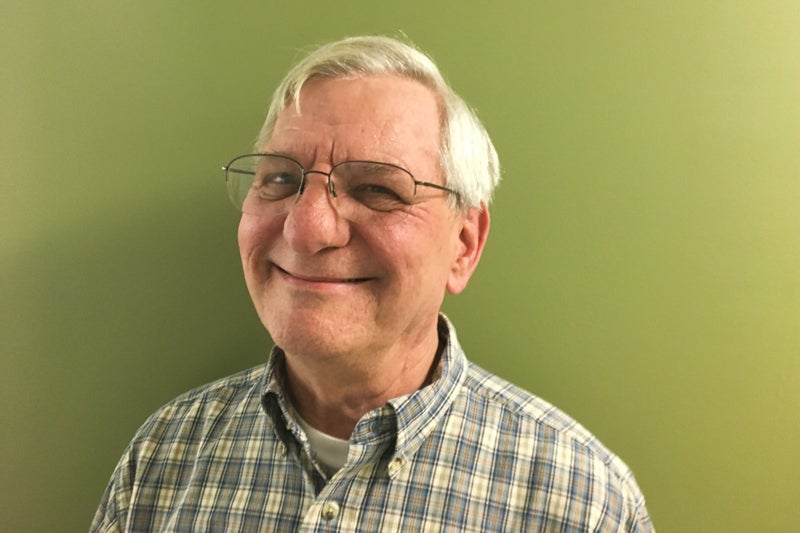
Initially, Salber says his daughters had to really button him to nourish the group because he was agape to leave and not existence able to speak well effectually others. Had he non come up, he says he'd probably still exist staying inside his house well-nigh of the time.
"I don't think my speech would exist as proficient as it is right now, and I'd exist sitting at home just wondering what to practise," he said.
Twenty years ago, this aphasia eye might have been one of simply a small scattering nationwide. Now in that location are about xx in North America, according to Antonucci. For Charlie and several others who attend the group, they say spaces similar this, that encourage social interactions, are a lifeline. For i, it enables them to do something that is really hard to exercise exterior, and equally a result can be a major bulwark to engaging with the world. Here, they can finally complete their sentences, no affair how long that might take.
"Information technology may audio foreign to you, but it's important that people empathize that people with aphasia need fourth dimension to end their sentences. Don't interrupt them. That's the probably worse thing you can do, because it's very, not only demeaning, but it's — what'south the word i'm looking for — "
Salber pauses for moment, until he finds it. Then with a firm voice, he completes his thought.
"Destructive to their confidence."
Source: https://whyy.org/segments/following-stroke-finding-words-can-lifelong-endeavor/
0 Response to "Does Reading Help With Word Finding After a Stroke"
Post a Comment